

By Andrew Roth, Scholar-in-Residence
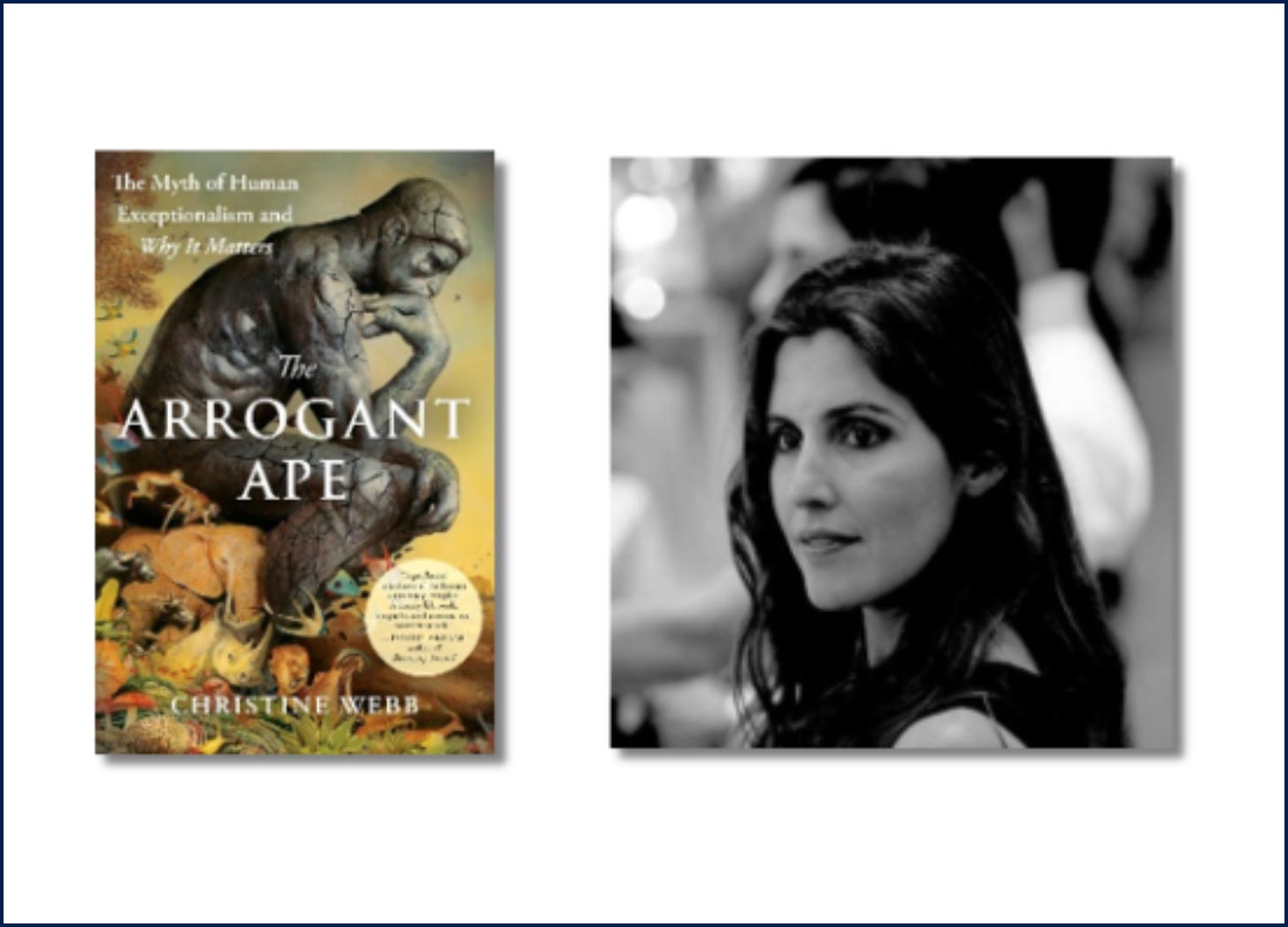
Are humans animals?
Are humans different from other animals?
What might humans learn from their shared animality with other animals?
The last question intrigues me. I thought I had just made up the word animality only to discover that it already exists and has a specific meaning. According to Merriam-Webster, it means “a quality or nature associated with animals; vitality; the animal nature of human beings.” [1] One of the examples of its usage cited by Merriam-Webster speaks directly to the concerns of Christine Webb’s The Arrogant Ape: The Myth of Human Exceptionalism and Why It Matters. [2] As an example, it offers, “In other words, humans can act against the animal component of their nature and manifest their humanity by rejecting its animality.” [3]
Which rejection, of course, is what Webb’s book argues against. A primatologist on the faculty at New York University, her essential point is that rejecting our animal origins and our close relationship to other living flora and fauna has resulted in humans’ alienation from the natural world and a corresponding loss of respect for nature.
That loss of respect for nature has results both profound and trivial. On the trivial scale (I guess not so trivial if you own the house), humans can persist in building homes directly on the seacoast only to have them repeatedly washed away because nature is going to do what nature is going to do, human ego notwithstanding. On the profound scale, it has resulted in human exploitation of other animals as research subjects, food sources, and a general exploitation of the natural environment resulting in climate change threatening all life on planet Earth.
A research scientist, Webb recognized her own hypocrisy in arguing for animal rights while still doing laboratory-based research. She moved from that to field-based observations of primates in their natural habitats, primarily baboons, whose emotive behavior she describes in detail. That animals have emotions won’t surprise any pet owner or anyone who attends closely to the behavior of the animals they encounter. Once, walking on Presque Isle, I noted a turkey who had espied me approaching him. Standing tensely alert, his eyes following me as I slowly passed, then he then visibly relaxed as he recognized that I posed no threat.
Perhaps because there is no resolution to it, Webb never does resolve the moral quandary arising from the fact that we use emotive animals as food. An omnivore myself, who has no particular desire to starve, I confess that I am sometimes uneasy as I nosh my Kung Pao Pork while suppressing any thoughts of its origins.
As usual, both more subtle and less judgmental than Webb, poets have had something to say about this. I happened upon one last week — Ruth Stone, a fine poet we’ll revisit in a future note, had this to share about the emotional life of animals.
Another Feeling
Once you saw a drove of young pigs
crossing the highway. One of them
pulling his body by the front feet,
the hind legs dragging flat.
Without thinking,
you called the Humane Society.
They came with a net and went for him.
They were matter of fact, uniformed;
there were two of them,
their truck ominous, with a cage.
He was hiding in the weeds. It was then
you saw his eyes. He understood.
He was trembling.
After they took him, you began to suffer regret.
Years later, you remember his misfit body
scrambling to reach the others.
Even at this moment, your heart
is going too fast; your hands sweat. [4]
***
That humans are animals yet somehow different from other animals (almost certainly not nearly as much as we think) is a notion with which it is impossible to argue.
But what is that difference?
Over the ages, humans have offered a variety of answers to that question, only to cast each aside when we discovered that other animals shared the trait. We first defined ourselves as tool makers, only to discover chimps and birds make tools. Then we defined ourselves as the “ape that spoke.” (I once had a book by that title.) Only to discover that other animals have language; in some instances, very sophisticated language. Then humans upped the ante and defined themselves as storytellers. Only we can weave our grunts and exhalations into long, complicated narrative tales around which societies organize themselves, or so Yuval Harari asserts in Nexus: A Brief History of Information Networks from the Stone Age to AI. [5]
To tell a story, however, assumes (requires?) self-awareness.
And self-awareness requires consciousness.
Which is what and where did it come from?
Answering those two questions will take us down a rabbit hole that makes Alice’s adventures with the white rabbit seem lucid and transparently clear. A friend told me a story about another friend who attempted to earn a doctoral degree in the history of consciousness. No surprise. He never finished.
To answer the first question –– what is consciousness –– the simplest, dictionary definition defines consciousness as “the quality or state of being aware especially of something within oneself.” [6]
Are other animals conscious? Are they self-aware? Perhaps, but at the moment, the answer to those questions remains problematic.
But humans are.
Where did consciousness originate? I remember reading about speculation that consciousness arose from the left hemisphere of the brain communicating with the right hemisphere through the corpus callosum, that thick bundle of nerves connecting the two.
Maybe, but while operationally possibly correct, it sheds little metaphysical light on the subject.
In the Book of Genesis, it is said that Adam and Eve became aware of good and evil by eating of the tree of knowledge. Before that they were innocents, which suggests they were blithely un-self-aware.
Webb examines at length what she calls “Terror Management Theory,” which says that humans’ fear of dying leads them “to deny our own animality.” [7] I think that gets as close as we’ve gotten to the origin of consciousness. Humans parted company with other members of the animal kingdom when we became conscious of the fact that we die.
Do other animals know that they die? No one, from my reading anyways, knows the answer to that question.
But humans know it.
We go to great lengths to deny that incontrovertible and unavoidable fact. We’ve imagined reincarnation and life after death to calm our fears of dying. Do they exist? No one knows. It is, as they say, a matter of faith.
What we do know is that we die.
I think that realization was the dawn of human consciousness. It predates Homo sapiens and almost certainly goes back past the Neanderthals, who practiced funerary customs, to at least the time of Homo erectus, who evolved from toolmaker Homo habilis, who lived from two million years ago to as recently as 108,000 years ago. Human awareness of death might precede Homo habilis. Trying to pin down the exact, in which exact is a very relative term, date is an exercise leading nowhere.
What we know is that fear of death is the fundamental metaphysical phenomena of human culture. Trying to cope with it gave rise to both religion and art.
Knowing that we die as the origin of self-awareness animates the oldest known human story. Not the oldest story, but the oldest known story for which a text exists. It is the ancient Sumerian epic of Gilgamesh. It is at least 5,000 years old. Gilgamesh, king of Uruk, embarks on a quest to understand death because at the death of his friend Enkidu, he can no longer bear the burden of knowing he will die. He journeys to the end of the world. There in a reply to his question about the meaning of life, he learns, “This is it; this is all there is but it’s more than enough,” to paraphrase. Now seeing clearly, no longer shielded by a fog of innocence, Gilgamesh returns to his kingdom of Uruk and “sees it for the first time.”
from Gilgamesh:
When at last they arrive, Gilgamesh
said to Urshanabi, “This is
the wall of Uruk, which no city on earth can equal.
See how its ramparts gleam like copper in the sun.
Climb the stone staircase, more ancient than the mind can imagine,
approach the Eanna Temple, sacred to Ishtar,
a temple that no king has equaled in size or beauty,
walk on the wall of Uruk, follow its course
around the city, inspect its mighty foundations,
examine its brickwork, how masterfully it is built,
observe the land it encloses: the palm trees, the gardens,
the orchards, the glorious palaces and temples, the shops
and marketplaces, the houses, the public squares. [8]
***
T.S. Eliot does something similar in his Four Quartets, about which I have written in several Book Notes that can be found here. Four Quartets is Eliot’s poetic mapping of his religious and metaphysical journey to self-understanding fired by the knowledge that his journey will one day end. Seeking to understand that ending, he metaphorically recreates the journey of his dawning self-awareness to his final epiphany. “Little Gidding,” the quartet’s final poem ends, like Gilgamesh, revisiting the metaphorical beginning:
from Little Gidding
We shall not cease from exploration
And the end of all our exploring
Will be to arrive where we started
And know the place for the first time. [9]
***
This is a classic notion in modern literature: we only begin to live when we realize we die. Camus said, quoting Shakespeare’s Hamlet, “To be or not to be” is the only valid philosophical question. It can only be answered when one realizes there will be a time when you are not. So, the poets and philosophers were there long before Webb’s The Arrogant Ape.
What the poets realized is that this is the only life you get. Whether that realization separates us from the rest of the animal kingdom is a question whose answer I do not know.
But I do believe this is the only life you get. So, the challenge then is whether to weep in self-pity or to answer Mary Oliver’s question, “What will you do with this one and only precious life?” She asks that question in her poem “Summer Day.”
from Summer Day
Who made the world?
Who made the swan, and the black bear?
Who made the grasshopper?
This grasshopper, I mean —
the one who has flung herself out of the grass,
the one who is eating sugar out of my hand,
who is moving her jaws back and forth instead of up and down —
who is gazing around with her enormous and complicated eyes …
I don’t know exactly what a prayer is.
I do know how to pay attention …
Doesn’t everything die at last, and too soon?
Tell me, what is it you plan to do
with your one wild and precious life? [10]
***
In “Sunday Morning,” Wallace Stevens tries to answer that question. Poets in the early 20th century struggled with the knowledge of death in a world in which religion no longer seemed to provide either answers or solace. Stevens’ response, much like Oliver’s, Camus’, and the unknown bard who transcribed Gilgamesh, was to avoid despair by embracing the wonder that is life itself.
from Sunday Morning
Supple and turbulent, a ring of men
Shall chant in orgy on a summer morn
Their boisterous devotion to the sun,
Not as a god, but as a god might be,
Naked among them, like a savage source.
Their chant shall be a chant of paradise,
Out of their blood, returning to the sky;
And in their chant shall enter, voice by voice,
The windy lake wherein their lord delights,
The trees, like serafin, and echoing hills,
That choir among themselves long afterward.
They shall know well the heavenly fellowship
Of men that perish and of summer morn.
And whence they came and whither they shall go
The dew upon their feet shall manifest. [11]
***
The point of Gilgamesh, Camus, Oliver, and Stevens is “pay attention to the present,” or as I have said in numerous Book Notes, be present-to-the-present if for no other reason than it is all you have. By the way, you don’t have to go to an ashram to be present to the present: sit quietly and listen to the sounds around you.
It is simply to delight in the miracle of life –– to savor by paying close attention to the world around you that you got to live at all.
What a gift, even if it is only the result of an infinteismal statistical probability in an infinite universe of other infinite universes. This morning in my newsfeed an article by Alan Lightman in The Atlantic stated the case that, “Being alive at all is the most extraordinary stroke of good luck any of us will ever experience.” [12] After detailing the immensity of the universe –– like Gilgamesh at Uruk, beyond human imagining –– “the universe began about 14 billion years ago. That’s about one hundred million human lifetimes ago. Just as our entire planet is a speck in the cosmos, our individual lives are fleeting moments in the grand unfolding of time. … Or consider the process of human conception. … Each conception contains about a hundred thousand billion different possible combinations of DNA. In other words, there are a hundred thousand billion unique and different human beings that could result from each procreation event.” [13]
Lightman notes that “each of us has won a lottery with a hundred thousand billion different players.” [14]
Whether that makes us different from all other animals, I very much doubt. But it should give you great joy, because here you are reading this Book Note.
Go outside –– pay attention to the present –– smell the rain, taste the snow, enjoy the sun celebrating the fact that you got to be here at all.
Now, that’s a miracle.
Whether it makes us exceptional, I doubt.
So, dial down the arrogance and humbly be present-to-the-present.
Photo Credits
“The Arrogant Ape, cover,” at Penguin Random House available at The Arrogant Ape by Christine Webb: 9780593543139 | PenguinRandomHouse.com: Books accessed June 18, 2026.
“Christine Webb, Ph.D.” at cewebb.com available at Dr. Christine Webb accessed June 22, 2026.
End Notes
“Animality,” at Merriam-Webster available at ANIMALITY Definition & Meaning - Merriam-Webster accessed June 22, 2026.
Webb, Christine. The Arrogant Ape: The Myth of Human Exceptionalism and Why It Matters (New York: Penguin Random House, 2025, Kindle Edition.)
Merriam-Webster, cited above.
Stone, Ruth, “Another Feeling,” at Poem Hunter available at Another Feeling - Another Feeling Poem by Ruth Stone accessed June 18, 2026.
Harari, Yuval. Nexus: A Brief History of Information Networks from the Stone Age to AI (New York: Random House, 2024).
“Consciousness,” at Merriam-Webster available at CONSCIOUSNESS Definition & Meaning - Merriam-Webster accessed June 22, 2026.
Webb, cited above, p. 222.
Mitchell, Stephen, tr. Gilgamesh: A New English Version (New York: The Free Press, 2004), pp. 198-199.
Eliot, T.S., “Little Gidding,” in T.S. Eliot The Complete Poems and Plays 1909-1950 (New York: Harcourt Brace and Jovanovich, 1971), p. 145.
Oliver, Mary, “Summer Day,” in Devotions: The Selected Poems of Mary Oliver (New York: Penguin Books, 2017), p. 316.
Stevens, Wallace, “Sunday Morning,” in The Collected Poems of Wallace Stevens (New York: Knopf, 1978), pp. 69-70.
Lightman, Alan, “The Ordinary Miracle of Existing,” in The Atlantic (June 2, 2026) available at The Ordinary Miracle of Existing - The Atlantic accessed June 22, 2026.
Ibid.
Ibid.

Andrew Roth, Ph.D., is a Scholar-in-Residence at The Jefferson Educational Society. Reach him at roth@jeserie.org.