


Editor’s note: Pardon coaches Parris Baker, Antonio Howard, and Diane Chido will discuss, along with Margaret Simms, her long journey to obtain a pardon at 6 p.m. Thursday, June 11, at ECAT: Erie Center for Arts and Technology, 650 East Ave. Please register for the free program by calling the Jefferson at 814.459.8000. JES Satellite programming is sponsored by Erie Insurance.
By Parris Baker and Diane Chido
We introduced readers to Margaret Simms and her quest for full justice in the form of a pardon from the commonwealth of Pennsylvania through an essay in February 2025. Simms is still on that quest. At the time of the first essay, we had spent nine months preparing her application and submitted it in October 2024.
In September 2025, her case was reviewed by the staff at the State Board of Pardons. There were several requests for additional case information that we did not have. For three months, I left messages at the Allegheny County Courthouse phone number they had given me since the original conviction occurred in Allegheny County in 1980. To briefly recap what happened: Margaret was convicted of fraud for making false statements about her income on forms for welfare assistance; Margaret maintains that it was not her intention, the forms were just very confusing. In January 2026, I wrote a letter to the Allegheny County Court of Common Pleas President Judge and to the Erie County Clerk of Records, Aubrea Hagerty-Haynes, requesting help in getting the information we needed to move the pardon process forward.
Hagerty-Haynes responded right away and contacted her counterpart in Allegheny County that very day. I received an immediate phone call from a staff member in the Criminal Division who took the information and promised to email me the case information within the week. He did. This fully satisfied the Pardon board’s request.
Restitution Road
On Feb. 23, 2026, I received a letter from the Pardon board informing us that Margaret’s pardon application had been filed and that the Merit Review Board would be voting on whether to proceed with the process. My pardon coach, Antonio Howard, was completely shocked. He thought it would take another two years or more to get to that point. For the process to continue, both Erie and Allegheny County’s prosecutor offices must agree the application has merit and sign off on it. Margaret had already paid any outstanding fines to Erie County, but we had no idea what would happen in Allegheny County, especially if its process is to refuse based on nonpayment of fines.
Now we had a new problem we’d known about but thought we had more time to manage. This was confirmed by a follow-up email from the truly kind and patient people at the Pardon board: Margaret had over $8,000 in outstanding court fees and fines going back to 1980. If she did not at least show a record of attempting to pay them, her pardon application would be denied. Roughly half of these fines were in collection, and a 25% surcharge of $1,007 would be added to the original cost when she paid those.
That day, I sent an email to Allegheny County to request a payment determination hearing. This would allow Margaret to get on a monthly payment plan but would require our appearance in court in Pittsburgh on an appointed date. On March 17, I received a response that I had petitioned the wrong court and was given a phone number to call. I called several times with no response. Finally, after a tearful conversation with Antonio, we determined Margaret was faced with a Faustian dilemma: she could start paying fines, but this would undoubtedly cause the collection company to harass her, or she could decide not to pay the fines and lose the pardon. My heart was breaking when I called to tell her this. Afterward, I felt physically sick and as if we had intentionally taken her to this impossible place.
About an hour later, my despair gave way to anger that the system was putting her in this bind, and I was determined to find a way to resolve this latest hurdle. I called the helpful gentleman at the Allegheny Criminal Division, knowing this was not his job. I explained the situation and he gave me the name and number of whom to call in the court’s financial collection division.
They answered my call, commiserated with the situation, and sent me an email the following week with the docket numbers of the outstanding fines, marking the ones in collections with yellow highlights. They told me exactly where on the Pennsylvania Justice Portal to pay the fines. Margaret and I had tried the previous week, but it asked for far more information than we could provide to proceed. We had again been in the wrong place.
I went to the Justice web portal, and following instructions, I paid $20 of a $174 fine as a test. It went smoothly. I authored an email to Margaret with step-by-step instructions on how to make payments, sending her the list and telling her NOT to pay the highlighted ones. I sent the receipt to the Pardon board, and they responded that the information would be included in Margaret’s file.
I called the number provided by financial collection and requested a form to petition the court to order the fines to be released from collection and returned to the court. I left a voicemail but got no response. After a week of trying, I finally reached someone who said we had to pick up the form in Pittsburgh. I begged for a mailed copy and with the Easter holiday, she told me to expect it by April 7. By April 21, I still had not received it. I called again and this time I was asked for the case numbers. The person on the phone took down the numbers and said she would mail “them” the next day. The first time, no one asked me for case numbers, and I was led to believe I would only receive a single blank petition.
When we finally received the neatly filled out petitions to have her fines removed from collections on April 26, Margaret signed them all, and we sent them back the same day. After months of trying to find the way to do this, we received them all back signed and approved by an Allegheny County judge in two weeks. Now she can safely work to pay all her fines without the extra $1,007 surcharge and with no threat of harassment.
I showed Margaret how to pay her fines online. She made her first $40 payment, a stretch for her budget, plus a $1.10 surcharge for online “convenience.” Despite this, she was euphoric. She said, “Today is my 17th anniversary in recovery. What a perfect way to celebrate another step toward freedom.”
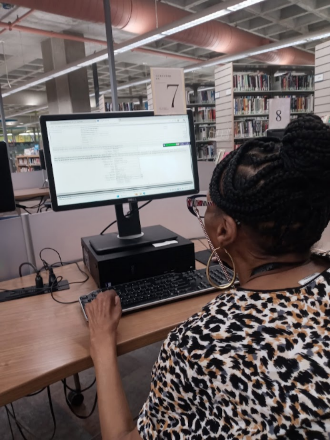
This woman cannot be beaten. I took her photo to commemorate her paying her first installment toward that freedom. Then I paid the rest of the $154 fine and sent the receipt to the Pardon board to add to her application. One down, a whole bunch to go.
The Power of Community Support
I have been telling my friends about this saga from the beginning. When I explained about the thrill of finally being able to pay the fines, one of them handed me all the cash in her wallet without a word. Another friend who knows Margaret well said, “$8,000 — we can easily raise that.” I was shocked. I hadn’t imagined doing that. Then, I decided to look at my network and use any social capital I have built over the years. In no time, I had dozens of people willing to contribute. Dr. Parris Baker, another pardon coach, said he would ask his church for a donation and all the other churches too! But a new problem arose. How to legitimately collect the money and give people receipts. They couldn’t just keep handing me cash or checks and having me put it in my bank account, trusting it would go to the right place.
I mulled this problem over for a week. Then I had an idea. Maybe the Erie Community Foundation could help us establish a fund that would allow us to collect money and pay it out right away to pay these fines. Then we could use it to request further donations to grow a larger pool to invest and help more pardon applicants from Erie County or now living here. Once again, I tapped into my network and called a friend at the Community Foundation. He arranged a meeting with the appropriate staff members. They were entirely supportive of the effort but said we had to have a 501(c)3 organization to accept the money through their fund.
Then I spent another week trying to figure out how to start a nonprofit. After many fits and starts and kind and helpful advice from knowledgeable friends, Pastor Parris and I wondered if his nonprofit church, Believers International Worship Center, could have a separate account earmarked to accept donated funds directly and pay Margaret’s and other worthy pardon applicants’ fines through that.
Helpful friends explained that it was entirely appropriate, and we would not need to involve the Community Foundation or set up a new entity after all. Parris called his bank and set up the bank account. I never had expected so many complexities when I signed up as a pardon coach. However, as Antonio keeps reminding me, filing the application is the coach’s whole job. Everything that has happened since was because we would not quit while Margaret still needed support because we love her and believe in her.
As we continued discussing the situation, we realized that Margaret’s case is a unique outlier. We are highly unlikely to encounter another person wanting a pardon for nearly 30 convictions and owing so much in court fines and fees. Rarely would we encounter an applicant with cases outside Erie County, where we can just pop over to the courthouse and get the information we need at a moment’s notice. They would mainly have one or two convictions and fees of a few hundred dollars, still out of reach for many, but not so much that we needed a huge nest egg to help them.
Epiphanies
I have learned many things through this process. One is an epiphany that hit like a thunderbolt as I tugged at the system and tried to force it to work for Margaret instead of against her. Antonio calls these moments my “epiphanies.” These moments when I first realize something that people on the bottom rung know intuitively. I gained a deeper understanding of the concept of “white privilege.” This phenomenon is real and I have it. I came to understood at one time that our institutions are “broken,” which seemed like an epiphany. Then I had a real one at the 2020 Juneteenth celebration listening to a speaker in Perry Square, when I realized they are functioning precisely the way they are meant to. Our institutions ensure that it is nearly impossible to come back from poverty or criminality; let alone both.
A felony conviction is like a permanent brand. As Antonio says, it is a constant reminder that you are forever defined by the worst day of your life. The day it all unraveled. Yes, you can apply for a pardon, but the process is so complex, it is nearly impossible to navigate without a high level of administrative skill, as described in Part I. Also required is to at least show you are trying to pay your court costs and fines. However, this is easier said than done when formerly incarcerated people are denied jobs and promotions at far higher rates than others.
I understood that white privilege is the fact that you are welcome everywhere. You will not get pulled over by legal authorities for driving in the wrong neighborhood or driving an expensive car. I understood that it means you can walk into any establishment and will be greeted politely and anyone there will pay respectful attention to any requests and attempt to assist you without derision or delay.
But white privilege is far deeper than this. It is the inherent knowledge that the systems in place are there to serve you. When they seem to be “broken,” you think it is just one lazy or incompetent bureaucrat, and you know you can break through that broken part and find the answer or result you want. You are willing to persevere through obstacles because you have confidence that you can. You know you just need to find the right person who can help unstop the blockage. You have friends and colleagues with expert knowledge who will help you easily find that person or access the knowledge you need in the law, accounting, nonprofits, healthcare, etc.
If you have never seen the system work for you, you do not even have the belief that your efforts could succeed so you may not even try. This is why discrimination is so deep and pervasive, because when you are a member of the targeted group, you feel your lack of power and often give up, not even knowing where the obstacles will appear and you eventually realize they exist to ensure you do give up trying to remove them.
With my white privilege I refused to give up. I asked my network how to get through. I sent letters and made phone calls endlessly until I found the right person in authority who could unlock the first door, I had the confidence to ask them for the key, and they were willing to turn it in the lock so I could continue to progress through the next. Trying this again and again, I was able to finally make Margaret’s first payment toward restitution and then reach back and show her how to do it.
The Cost of a Criminal Record
The U.S. Chamber of Commerce America Works Data Center published an article in 2024 noting that at that time, 1.25 million Americans were incarcerated and 3.7 million were on probation or parole. Further, 1 in 3 Americans have a criminal record and:
The majority of individuals in prison are working-aged men. The unemployment rate for those with a criminal record is 30%. More than 93% of formerly incarcerated individuals between the ages of 25 and 44, those in their prime working age, are actively working or looking for work. In comparison, the broad population of individuals in a similar age group (25-55) are participating in the labor force at a rate of only 84%.
On average, individuals who have been imprisoned face a dramatic wage reduction of 51.7%, amounting to a staggering $55.2 billion annually equivalent to the cost of purchasing the Louvre. Those with felony convictions, even those that don’t result in prison time, see their earnings reduced by 21.7%, translating to $77.1 billion, a sum that could fund the operation of the International Space Station for 26 years.
Even a misdemeanor conviction can lead to a 16% decrease in wages. Given the prevalence of misdemeanor charges in the U.S., this results in an annual economic loss of $240 billion. This amount could buy every single NFL team and most of the NBA teams in the nation.1
Clearly, the trouble with the system is that it does not just harm those who are not meant to benefit from justice. As President Lyndon B. Johnson said at the signing of the Voting Rights Act in 1965, “There is no Negro problem. There is no Southern problem. There is no Northern problem. There is only an American problem,” emphasizing that racial injustice damages the entire nation.2
Why We Share This Story
Margaret Simms, a petite, disabled, Black woman — and convicted felon — has been engulfed in a half-century crusade to personally experience America’s cherished democratic status: full citizenship. Unlike the rich, slick, and guilty, who can evade or defer the consequences of illegal behavior or serve their time in luxurious confinement, Margaret has carried the full weight and stigma of her charges. These were put in place from 1980 through 2007 mainly for crimes of prostitution and drug possession, acts that only hurt Margaret herself, due to years of untreated addiction and sometime homelessness.
Though exhausted, Margaret has doggedly pursued the American dream, with a commitment to complete the task – for herself and for her family. What is absolutely amazing is that amid the maze of munitions, the procedural booby traps, the “Oops, you’re in the wrong line,” and the financial minefields, that even court personnel cannot navigate; Margaret has not given up nor is she bitter. She is, however, battered, frustrated, and bewildered.
Lost and locked in an unnecessary maze of judicial complexities, poor Black women like Margaret, often experience unique forms of victimization within the criminal justice system. Unwittingly, they face the intersectional effects of race, gender, economic inequality, and societal prejudice and discrimination. Formerly incarcerated Black women are not as fortunate as the rich and well-connected, whose access to legal and financial capital acts like a shield, protecting them from prosecution and incarceration.
Margaret, who is on the other end of the spectrum, is constantly penalized for being legally, socially, and financially impoverished. She operates in a system whose mission, in theory, is to provide rehabilitative services that were designed to reduce recidivism and facilitate successful reintegration. However, in reality, what Margaret receives is stifling rules, “boa” restrictions, unrealistic expectations, and asphyxiating and insurmountable financial obligations.
The empty acknowledgments from well-meaning people regarding her personal commitment to redemption, restoration, and her recovery have not brought Margaret one day closer to being pardoned. Understanding the experiences of poor Black women requires recognizing that the criminal justice system does not operate in isolation. It is a network of intertwined systems that exacerbate social and economic inequalities that can leave many women trapped in a web that punishes vulnerability rather than addressing its root causes.
We write to share all this with interested readers not to solicit donations, although we hope it will impress the Merit Review Board to know so many people in her home community are coming together to ensure her pardon. We write it in the hope that educating people, who will never have a soul-crushing experience with the criminal justice system, will care enough to help us try to change it. We hope people with our power can help us find the mercy in American justice and help others regain their souls and strength as Margaret has done.