

By Andrew Roth, Scholar-in-Residence
How many wars have anti-war, pro-peace works of art actually prevented?
What is it about humans knowing that wars are self-destructive, vicious sources of enduring pain, yet cannot help themselves waging them again and again and again and again?
These thoughts occurred to me while preparing some remarks for a WQLN roundtable about the war poems of Wilfred Owen and Benjamin Britten’s War Requiem, which The Erie Philharmonic will perform on May 9 at 7:30 p.m. at the Warner Theatre. Tickets can be purchased at Events for Erie Philharmonic or by calling 814-452-4857.
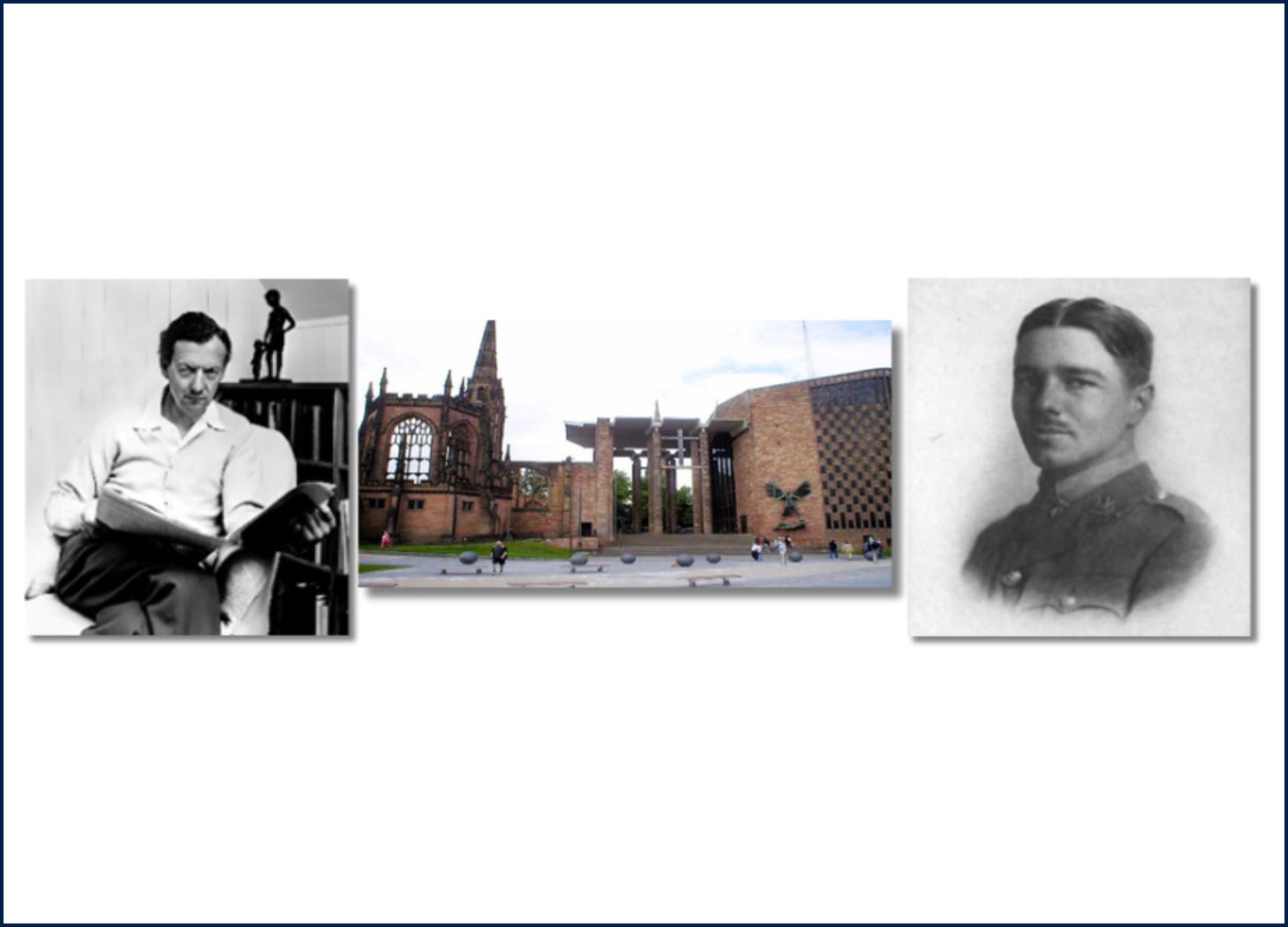
England’s first composer of international stature since Henry Purcell in the 17th century, Britten completed the War Requiem in 1961 at the height of Cold War nuclear tensions; 1961 was the year of the Bay of Pigs fiasco and the construction of the Berlin Wall. In an era suffused with nuclear dread, it debuted on May 30, 1962. It marked the reconsecration of the new Coventry Cathedral resurrecting the 14th century cathedral destroyed by German bombers during World War II. Seeking to signal rebirth and permanence in the face of catastrophe, the new cathedral adjoins the ruins of the old.
With the Catholic Church’s Mass for the Dead as scaffolding, Britten interlaces his requiem with nine war poems by Wilfred Owen to create, as Michael Steinberg said, “the collision of innocence with wickedness and corruption, innocence outraged by it.” [1] “Innocence outraged” is the liturgy’s quiet promise of peace colliding with the terrible beauty of Owen’s depictions of war’s cruelty.
The Introit, the First Movement “Requiem aeternam …” (“Eternal Rest”), begins with the chorus and boys choir (Innocence) singing the traditional Latin text — “Eternal rest give to them, O Lord … let perpetual light shine upon them (Psalm 64. 2-3) … all flesh shall come to Thee. Eternal rest give unto them. …” [2] Britten counters with a solo tenor singing Owen’s “Anthem for Doomed Youth.” In the first stanza, Owen captures the mechanical violence of modern warfare and then links it with “bugles calling from sad shires” to the second stanza’s contrasting funeral customs that shine in the eyes of the youthful dead as “holy glimmers of goodbyes.”
Anthem for Doomed Youth
What passing-bells for these who die as cattle?
Only the monstrous anger of the guns.
Only the stuttering rifles’ rapid rattle
Can patter out their hasty orisons.                                          Orisons = prayers

No mockeries for them; no prayers nor bells,
Nor any voice of mourning save the choirs, —
The shrill, demented choirs of wailing shells;
And bugles calling for them from sad shires.

What candles may be held to speed them all?
Not in the hands of boys, but in their eyes
Shall shine the holy glimmers of goodbyes.
The pallor of girls’ brows shall be their pall;
Their flowers the tenderness of patient minds,
And each slow dusk a drawing-down of blinds. [3]
***
Who was Wilfred Owen and why is he important?
Along with Rupert Brooke, Siegfried Sassoon, and Isaac Rosenberg, Owen was one of the foremost poets to emerge from the carnage and chaos of World War I. Over the course of the 20th century, he became acknowledged as the English language’s pre-eminent anti-war poet. For many, he remains so to this day. Anti-war, however, is not quite right. I agree with Britten’s implied insight and prefer to think of him as a pro-peace poet who refuses to glorify war.
Why?
Owen shattered the romantic myth of war. Before him, almost all English language poetry glorified patriotic sacrifice. Think of Tennyson’s “Charge of the Light Brigade” or Rupert Brooke’s “The Soldier” that typify the style. Brooke, who joined the Royal Navy as the guns of August erupted into World War I in 1914, died in 1915 aboard a hospital ship on the way to the landings at Gallipoli. From high school English class, you might still hear a faint echo of Brooke’s famous opening line:
from The Soldier
If I should die, think only this of me:
     That there’s some corner of a foreign field
That is forever England….” [4]
In his most famous poem “Dulce et Decorum Est” (one interestingly enough, Britten does not use), Owen counters:
from Dulce Et Decorum Est
Bent double, like old beggars under sacks,
Knock-kneed, coughing like hags, we cursed through sludge,
Till on the haunting flares we turned our backs,
And towards our distant rest began to trudge.
Men marched asleep. Many had lost their boots,
But limped on, blood-shod. All went lame; all blind;
Drunk with fatigue…

Gas! GAS! Quick, boys!—An ecstasy of fumbling
Fitting the clumsy helmets just in time,
But someone still was yelling out and stumbling
And flound’ring like a man in fire or lime …
If in some smothering dreams, you too could pace
Behind the wagon that we flung him in …
If you could hear, at every jolt, the blood
Come gargling from the froth-corrupted lungs,
Obscene as cancer …

My friend, you would not tell with such high zest
To children ardent for some desperate glory,
The old Lie: Dulce et decorum est
Pro patria mori.* [5]
*From an ode by the Roman poet Horace, the phrase means “It is sweet and fitting to die for one’s country.”
***
Raised in a lower-middle-class family and strongly influenced by his mother’s religious zeal, Owen was educated in English public schools. He developed a talent for literature and thought of becoming a poet by the early age of 10. Lacking the finances to attend university, he tutored and began to seriously write poetry in France for two years before enlisting in the British Army in 1915. Commissioned as a second lieutenant, in January 1917 he was sent to the Western Front. Enduring constant artillery shelling and the harsh mud and cold of the trenches, over the winter months he led his men in repeated charges and hand-to-hand combat with the German enemy. Wounded, he spent several days in a near frozen shell crater sleeping with the bodies of his dead comrades. Rescued, he was sent to Scotland’s Craiglockhart Hospital suffering from “shell shock,” what we now call PTSD: post-traumatic stress disorder.
At Craiglockhart Hospital he met Siegfried Sassoon, an officer in the British Army and combat veteran. Sassoon was also an accomplished poet whose war experience led him to write a letter to Parliament renouncing the war and affirming his pacifism. His poem “Attack,” in which he wrote “… clumsily bowed With bombs and guns and shovels and battle-gear,/ Men jostle and climb to meet the bristling fire…” spoke to a new way to write about war. [6] Encouraged by Sassoon, Owen resumed writing poetry, shifting from the era’s conventional pastoral poetry to a realistic anti-war voice. Fusing technical mastery with moral purpose, Owen pioneered psychological realism. Not for him the fine phrases of headquarters; he gave voice to the common soldiers, to the men in the trenches’ front lines. Developed at Craiglockhart, his signature techniques were pararhyme (or half-rhymes like “groined/groaned”), vivid, shocking imagery, and the ironic use of Biblical and classical allusions.
He did not write sweet idylls about some plot of land that would be forever England; instead, he wrote “Out there, we’ve walked quite friendly up to Death,/Sat down and eaten with him, cool and bland/Pardoned his spilling mess-tins in our hand./We’ve sniffed the green thick odour of his breath. …” Owen focused his art not on himself but on the suffering (the “pity”) of soldiers. In a draft of an essay that was later used as a Preface to a volume of his poetry, he said, “My subject is War, and the pity of War.” [7]
Exempt from further combat and not required to go back to France, Owen, nonetheless, chose to return to active duty. Spurred by loyalty to his men, he also thought not returning would label him a shirker undercutting his poems’ moral stature. In September 1918, he returned to the trenches in France. That fall, he was awarded the Military Cross for valor in recognition of “an act or acts of exemplary gallantry during active operations against the enemy.” [8]
On Nov. 4, one week before the Armistice on Nov. 11, 1918, Owen was killed in combat while leading his troops to safety across the Sambre-Oise Canal in France.
He was 25 years old.
In an ironic symbol of the war’s senselessness, his family learned of his death as church bells rang celebrating peace.
His poems were published posthumously.
***
Owen’s poetry enriches Britten’s score. At each stage of the Mass, Britten uses Owen’s poetry to give voice to innocence’s outrage.
At the Offertory, the part of the Eucharist when the bread and wine are ceremonially placed on the altar symbolizing Christ’s sacrifice, Britten’s baritone sings from Owen’s Parable of the Old Man and the Young:
		Behold,

A ram caught in a thicket by its horns;
Offer the Ram of Pride instead of him.
But the old man would not so, but slew his son … [8]
At the Agnus Dei, which means “Lamb of God” and refers to Jesus Christ as the sacrificial lamb who takes away the sins of the world, the liturgy asks, “have mercy on me” and “grant us peace.” In counterpoint, Britten’s chorus and the tenor sing:
from A Calvary near the Ancre
The scribes on all the people shove
And bawl allegiance to the state,
But they who love the greater love
Lay down their life; they do not hate. [9]
The poems title refers to an incident in a chapel near the Ancre, a tributary of the Somme, when Owen saw a crucifix of the crucified Christ and used it as a symbol of the permanence of war and the suffering of its victims.
Britten’s most powerful use of an Owen poem is in the Libera me, which means “Deliver me.” Sung at the absolution of the dead beside the coffin after the Requiem Mass has ended and just before burial, the text asks God to have mercy upon the deceased at the Last Judgment. As commentary on the text, Britten deploys Owen’s “Strange Meeting.” In it the narrator has entered the afterworld and encountered the dead. He describes escaping battle “down some profound dull tunnel …” where he encounters “encumbered sleepers” who “groaned … too fast in thought or death to be bestirred.” One of the dead speaks to him.
from Strange Meeting
I am the enemy you killed, my friend.
I knew you in this dark; for so you frowned
Yesterday through me as you jabbed and killed.
I parried; but my hands were loath and cold.
Let us sleep now … [10]
****
Earlier I asked, “Why is Wilfred Owen important?” and answered my own question saying that he shattered the romantic myth of war; he exposed war not as noble adventure, but as mud, gas, blood, panic, and exhaustion. He rejected Victorian heroism to expose war’s brutality showing compassion for the troops who suffered it. Giving voice to the common soldier, he democratized war literature. Like Stephen Crane’s The Red Badge of Courage, Erich Maria Remarque’s All Quiet on the Western Front, Owen foreshadowed Ernest Hemingway’s poignant World War I novel A Farewell to Arms, Norman Mailer’s World War II masterpiece The Naked and the Dead, Robert Stone’s Dog Soldiers and James Webb’s Fields of Fire about America’s war in Vietnam, and films too numerous to mention.
Britten’s War Requiem does not answer the one essential question: Why is it humans have never learned war’s one essential message – war is futile. He ends the Requiem with the dead meeting in the afterworld, but earlier he used Owen’s “Futility” in the second movement’s Dies Irae –– “Day of Wrath” the opening words of the Latin hymn on the Last Judgment.
from Futility
Move him into the sun –
Gently its touch awoke him once,
At home, whispering of fields unsown,
Always it woke him, even in France,
Until this morning and this snow.
If anything might rouse him now
The kind old sun will know. [11]
****
And, yet, war goes on
As of 2026, there are approximately 56 active armed conflicts worldwide, according to the Uppsala Conflict Data Program. At least 10 major wars are causing significant casualties and displacement. The deadliest ongoing conflicts include the Russia-Ukraine war (since February 2022, 500,000-plus casualties), the Sudan civil war (since April 2023, 150,000-plus killed, 10 million-plus displaced), and the Gaza conflict (since October 2023, 40,000-plus killed). [12]
As Kurt Vonnegut’s Billy Pilgrim said in Slaughterhouse-Five, “So it goes.”
Photo Credits
“Benjamin Britten, London Records 1968 publicity photo for Wikipedia (restored).jpg” at Wikimedia Commons available at File:Benjamin Britten, London Records 1968 publicity photo for Wikipedia (restored).jpg - Wikimedia Commons accessed April 20, 2026.
.jpg)
“Coventry cathedral.jpg” at Wikimedia Commons available at File:Coventry cathedral.jpg - Wikimedia Commons accessed April 20, 2026.

“Wilfred Owen 2.png” at Wikimedia Commons available at File:Wilfred Owen 2.png - Wikimedia Commons accessed April 20, 2026.

End Notes
See Steinberg, Michael, “War Requiem,” at Boston Symphony Orchestra available at BSO | War Requiem and Anonymous, “The War Requiem” at Caltech available at The War Requiem both accessed April 20, 2026.
“Mass for the Dead,” at Franciscans of the Immaculate Maria USA Delegation at Mass for the Dead: Mass, Absolution, and Burial accessed April 20, 2026.
Owen, Wilfred, “Anthem for Doomed Youth,” in the public domain.
Brooke, Rupert, “The Soldier,” in the public domain.
Owen, Wilfred, “Dulce et Decorum est,” in the public domain.
Sassoon, Siegfried, “Attack,” at Englishverse.com available at Attack, by Siegfried Sassoon accessed April 26, 2026.
“Wilfred Owen 1893-1918” at The Poetry Foundation available at Wilfred Owen | The Poetry Foundation accessed April 25, 2026.
“The Military Cross,” at Identify Medals available at The Military Cross - British Medals & Awards, WW1, The Great War accessed April 21, 2026.
Owen, “Parable of the Old Man and the Young,” in the public domain.
_____, “At a Calvary near the Ancre,” in the public domain.
_____, “Strange Meeting,” in the public domain.
_____, “Futility,” in the public domain.
“Every active war and armed conflict in 2026,” at The World Now available at War Today — Every Active Conflict on the Globe, Live (2026) accessed April 26, 2026.

Andrew Roth, Ph.D., is a Scholar-in-Residence at The Jefferson Educational Society. Reach him at roth@jeserie.org.