


By Court Gould
During the 2000s many cities across the nation experienced a surge of new residents moving in. People were rethinking the trappings of suburban life in contrast to attractive qualities of cities such as walkable and bikeable access to amenities, tightknit neighborhoods, and efficiencies of living close to work. Enter Covid-19.
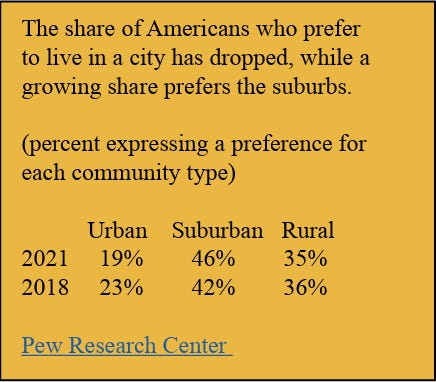
As is the title of a recent Bloomberg CityLab article, the pandemic has “supercharged suburban sprawl.” But, as the Pew Research Center reports, “While the survey shows some changes in the shares of Americans who would prefer to live in cities and suburbs compared with 2018, there is little evidence that people’s priorities in terms of what they consider important in a community have shifted considerably during this time (2021).”
People’s priorities are largely unchanged compared with before the pandemic. They desire signature qualities of urban life, which Erie, Pennsylvania needs to double down on to weather this period of upheaval. Now is the time to get back to the basics, to refocus on the seemingly little things that factor large in forestalling urban exodus.
Competition for Residents
Recent decades have seen intensification of the high stakes quest for population growth among communities. City and suburb have been locked in a contest for years to attract “ratables,” that is, taxpayers. The competition comes down to whether cities can retain or revitalize their high quality of life and unique city attributes at a rate faster than suburbs can remodel to be more like urban communities – all to satisfy rising demands of residents for the qualities cities uniquely have to offer compared to suburbia’s more homogenized and flattened contours.
In this way, suburbs are scrambling to retrofit character-less strip malls and cul-de-sacs in favor of “new urbanist” design and attractions that people increasingly want. This includes town centers with mixed-use main streets where locally owned shops are welcoming at street level with apartments above; public transportation; sidewalks that connect; diverse and ethnically rich communities; and proximity to entertainment, the doctor’s office, the arts, and education. Such characteristics have long been the hallmark of cities. They remain essential to retaining existing residents and attracting new neighbors.
In Erie, Pennsylvania, whose population has been declining over the decades since peaking just shy of 140,000 in the 1960s, accentuating the intrinsic qualities of urban life are foremost in the strategy to prosper. Of course, there are big ticket items that desperately need attention. High quality schools, public transportation, public safety, and health care are critical. All the while, attention can’t be lost on smaller necessities – the sorts of things that are often neglected – that urban dwellers expect and hold over suburbanites as examples of the advantages of city life.
The following scratches the surface of examining just a few signature offerings of the city of Erie that are perhaps underappreciated for their outsized impact, or downlisted in priority in favor of seemingly more pressing concerns. Nevertheless, these “lesser” city services are critical to retain and attract residents, and thus tax base to pay for the things people need and want.
Sidewalks and Trees
City sidewalks and trees near curblines define Erie’s blocks and whole neighborhoods. They deliver multiple returns on contributing to quality of life.
The present condition of Erie’s sidewalks and trees speaks both to priorities, finances, and perhaps departmental “siloing” of city services where their value is disconnected from other related civic matters. For example, sidewalks and curbline trees contribute to public health and safety, real estate valuation, social cohesion among residents, and even less crime relative to the broken windows theory and corollary to concentrations of poverty. It is not a stretch to argue that as goes the sidewalks and trees, so goes the neighborhood.
Sidewalks and curbline trees in Erie have in common how they are managed. Their care and maintenance are the responsibility of adjacent home or property owners. It’s the abutting property owner’s financial obligation to rectify decay. This governance model doesn’t work well for maintaining this urban infrastructure. Witness the wide variability in condition of Erie’s sidewalks and trees in different parts of the city. It is sad that in some neighborhoods,
wheelchair users have no choice but to use the street for safe passage. Simply trying to walk many of the city’s neighborhood sidewalks is a perilous trip-and-fall risk.
Given the co-benefits of sidewalks and trees, the city of Erie would be well-served to launch a fresh examination, tracking the differing models among cities regarding how best to manage both to maximize their key role in contributing to quality of life and positioning the city to retain and attract residents.
Pick Up the Litter
Another visceral signal of neighborhood character is the prevalence of litter. Trash-free blocks are another essential ingredient in the recipe to grow a city. Litter leads to decline and decline leads to litter. Littered streets send a strong self-reinforcing signal that people don’t care for the community and the community doesn’t care for its residents. A littered street signals lack of caring and begets more abuse. Where litter accumulates, crime follows, property values decline, people leave or certainly are not attracted to call a trashed street their new home – unless they have no choice.
Erie works hard to keep its streets clean. Weekly trash collection, street sweeping, improved streetlights, and snow plowing demonstrate tax dollars at work. But the city can’t get ahead of the challenge if littering is the norm. Perhaps as a simple public service, it can be expected of city government to place and maintain trash cans in neighborhoods. This needs to be further examined.
Governments often throw anti-littering education campaigns at the problem. Paid advertisements may be more easily implemented but they are expensive, must be sustained in the long term to have impact, and too often the messaging itself is unclear, confusing or dogmatic and can have the opposite effect of reinforcing the goal of less trash on the sidewalk or street.
The most effective solution to a litter problem is revealed by studies that show the most powerful way to break the cycle of littering is for people to see people picking up litter. The sight of others picking up trash changes the norm. The act of residents taking it upon themselves to clean up trash sends the stark message that “this is a place people care and will do something about.”
The city of Erie is off the hook on this approach as responsibility for getting people to pick up litter is rightfully the business of neighborhood organizations. Developing community-based litter leaders who are compensated to regularly pick-up trash on their blocks is a proven strategy. Such compensation can be very modest and comes in many different and creative forms of reward, such as stipends, work for food, public recognition, bus passes, gift cards, etc. An example comes from the South Baltimore Partnership, which used litter collection as an opportunity for community engagement. According to the Baltimore Sun, “In 2011, the neighborhood created a YouthWorks program to employ neighborhood youth to clean its streets. The initiative later grew to employ three adults who clean the streets each morning year-round, as well as children 8-13, who pitch in two Saturdays a month.”
Further innovations deploying technology are illustrated by entrepreneurs in Philadelphia who use a smartphone app called Glitter to recruit neighborhood workers, verify litter collection hours, and remit compensation that is funded by sponsors and neighbors who contribute to a fund online. This hyperlocal strategy is in step with common practice of business improvement districts, like the Erie Downtown Partnership, that use member fees to fund litter collection. The community organization, Our West Bayfront, is presently convening a committee to look comprehensively at the art and science of litter abatement. Its research of what motivates people is sure to inform the tack it takes and will be ripe for sharing among other organizers throughout the city.
While block-by-block organizing of litter cleanup is best left in the hands of neighborhood organizations, the city of Erie is responsible for numerous services that lend to sense of care. The following are issues residents depend on the city to address to create order and a sense of community caring:
- cars parked on the sidewalk
- clogged storm drains that cause water ponding on roads
- dangling utility wires to houses or customers who no longer exist
- code violations of many types both in homes and buildings and on their grounds
- nuisances such as loud music and backyard burning
To better address such quality of life issues, Erie could benefit from more staffing:
- to address code violations and issue quality of life warnings
- fire inspectors who work after hours and weekends when most outdoor burning occurs
- to proactively examine and fix storm drains
- to ticket cars parked on the sidewalk or junk cars in driveways and backyards
- to press utility companies to coordinate and remove wires no longer in service and abandoned poles
- improper storage of trash and junk in front yards
- inspect rental units and also ensure that repeat instances of emergency calls to rentals are shared between city and the Erie Housing Authority
As well-stated on the city’s website, these are “costly problems that contribute to the deterioration of property values and general disorder in a community. These problems degrade the physical appearance of the city, which reduces business and tax revenue, inhibiting economic development. The quality of life and community pride of the citizens of Erie are negatively impacted by the occurrences and existence of these activities.”
Erie has been losing for too long in the quest for retaining and attracting residents. The little things at the neighborhood level increasingly matter. This is especially true in these times when the pandemic is making the suburbs look all the more attractive to many. It is a catch 22 of sorts. More residents, or taxpayers, are needed for the city to be able to afford to mind its neighborhoods. But people can’t be expected to stick around or be enticed to move to the city if the basic quality of life conditions they expect aren’t up to par. People deserve choice. Erie needs to increasingly mind the basics, or it will see continuation of suburban growth at urban expense.
About the Author

Court Gould, who lives in downtown Erie, served 20 years as founding executive director of Sustainable Pittsburgh. He established the organization as a leader in accelerating the policy and practice of sustainable development borrowing from cities around the world regarding local strategies for Smart Growth, Regional Equitable Development, DEI, Transportation for Livable Communities, Energy Visioning and Strategy, Outdoor Recreation, Sustainable Community Development, Blight and Abandonment, Sustainable Business Strategies, and more.
After three years with the Erie Community Foundation as vice president of Community Impact, Gould is a sustainable solutions consultant and certified professional coach. His education includes an MPA from the University of Southern California, and a BA in Political Science from Tufts University. He attended the Stanford Graduate School of Business Executive Program for Nonprofit Leaders and earned Professional Coach Certification from Duquesne University.